
Choosing the Right Tile Adhesive for Your Project
Selecting the wrong adhesive can cause hollow sounds, debonding, and costly tile failures. Discover how to choose the right adhesive for every substrate.
1. Understanding Indian (IS 15477) & European (EN 12004) Standards
Modern tile installation has evolved far beyond traditional sand-cement mortar. The Bureau of Indian Standards (IS 15477:2019) categorizes adhesives into distinct performance classes:
• Type 1T (EN 12004 C1T): Suitable for standard porous ceramic and clay tiles on internal floors and plastered walls.
• Type 2T (EN 12004 C2T): Fortified with synthetic polymers for low-porosity vitrified tiles, porcelain, and tile-on-tile renovation projects.
• Type 3 (EN 12004 C2TE S1): Highly deformable (S1 deformability ≥ 2.5 mm) engineered for external facades, large slabs, and thermal movement zones.
2. Evaluating Tile Porosity & Format Dimensions
Ceramic tiles have high water absorption (>10%), allowing mechanical interlocking even with basic adhesives. Vitrified and porcelain tiles, however, have water absorption below 0.5%, meaning they rely entirely on polymer-modified chemical adhesion.
Installing low-porosity vitrified tiles with ordinary cement mortar will inevitably cause debonding as temperature fluctuations cause differential expansion.
3. Grey vs. White Cement Formulations
A frequent aesthetic error is installing translucent glass mosaics or white Italian marble with grey cement adhesive. Grey adhesive will cause 'shadow bleed-through' and dark edge framing that ruins the stone's appearance.
For light marble, glass mosaics, and natural limestone, always specify a pure white cement polymer adhesive like Evelino Tile Adhesive C1/C2 White to protect true color fidelity.
4. Proper Trowel Selection & Bed Thickness
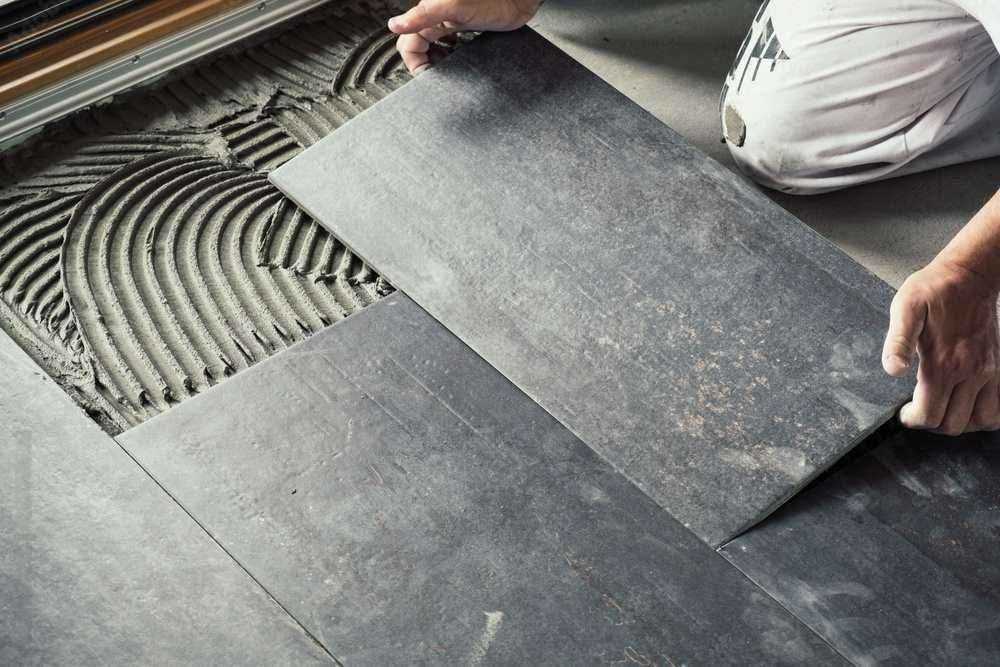
Never 'spot-bond' (dab adhesive in center and corners). This creates hollow cavities that shatter under localized impact. Use notched trowels (6mm to 10mm) and comb adhesive in straight, parallel ridges. For tiles larger than 300×300 mm, back-buttering the tile ensures 100% solid bed coverage.
💡 Pro Tip from Evelino Technical Team
"For large-format vitrified tiles (800×800 mm and above) or exterior wall cladding, always specify a deformable adhesive conforming to IS 15477 Type 3 and EN 12004 C2TE S1."